
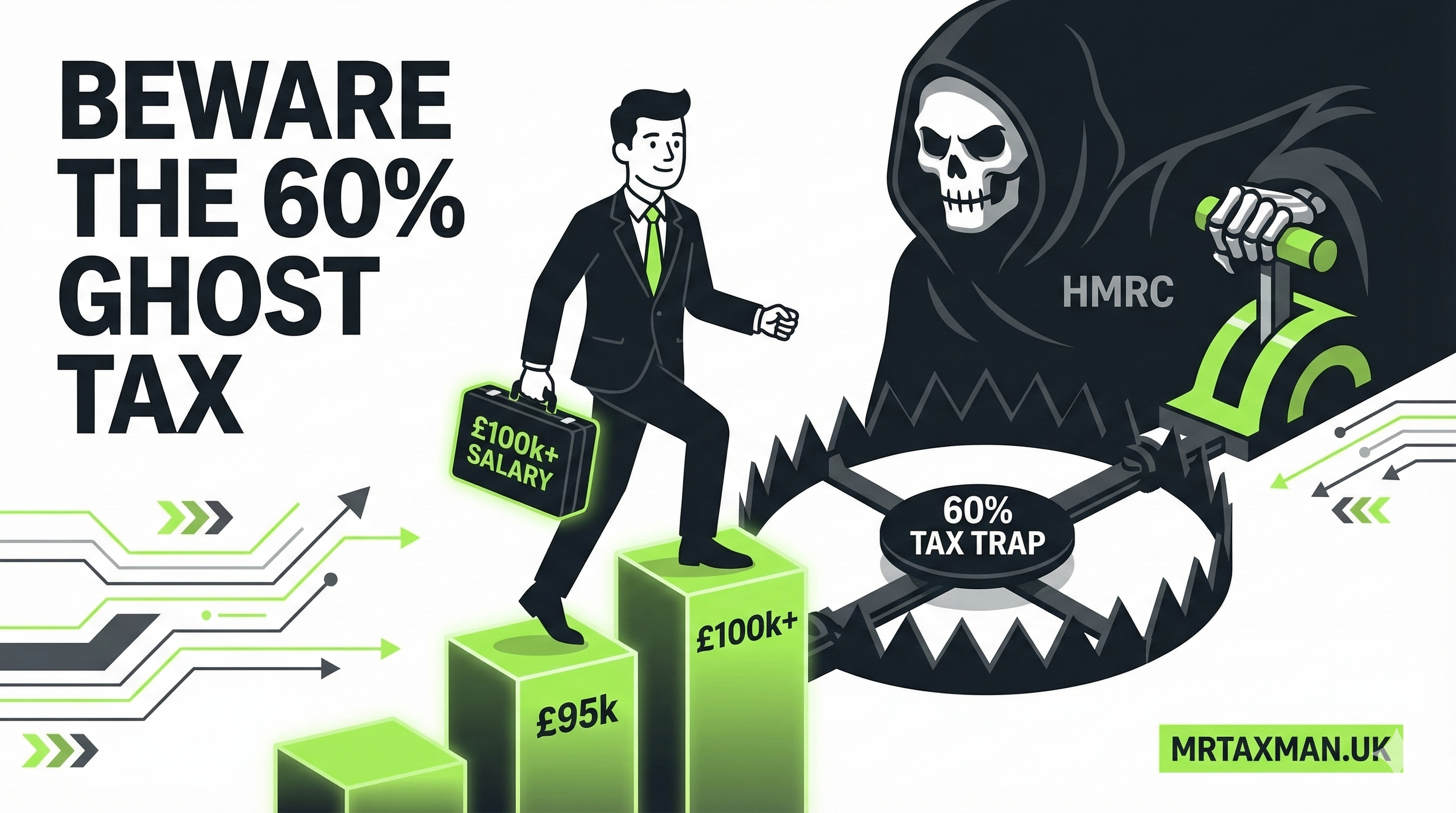
The £100k+ Success Trap: Is the 60% ‘Ghost Tax’ Haunting Your Personal Allowance?

April 5th is Looming

If you’re on track to earn over £100,000 this year, congratulations are in order—but so is a warning. In the UK tax system, the leap from five figures to six is where the taxman hides his sharpest teeth.

Between £100,000 and £125,140, you aren’t just a “higher rate” taxpayer. Due to a quirk in how the Personal Allowance is withdrawn, you are likely paying an effective tax rate of 60%.

Why does this happen?

Think of it as a “Success Tax.” For every £2 you earn over £100,000, you lose £1 of your tax-free Personal Allowance. This means that for every £100 in that “trap zone,” you pay £40 in Income Tax plus another £20 because your tax-free threshold has shrunk. If you live in Scotland, this rate can soar even higher to an eye-watering 67.5%. Toss in National Insurance, and you’re working mostly for the Treasury.

The Hidden Cost: Childcare & Benefits

The “trap” isn’t just about the tax on your payslip. Crossing the £100,000 threshold can trigger the loss of:

30 Hours Free Childcare: If one parent earns over £100,000, the household loses eligibility.

Tax-Free Childcare: The £2,000 per child per year government top-up vanishes.

For a family with two children, “earning” an extra £1,000 that pushes you over the limit could actually leave you thousands of pounds worse off after losing these benefits.

How to Plug the Leak Before April 5th

You don’t have to just “take it.” Your hard-earned money is leaking out of your pocket, but there are three primary ways to plug that leak before the tax year ends:

The Pension Power-Play:

A SIPP or workplace contribution is the most powerful tool in your kit. By moving that “trap zone” income into your pension, you effectively lower your taxable income back below the £100k mark.

Strategic Giving:

Gift Aid donations are subtracted from your “Adjusted Net Income.” It’s a way to support causes you care about while reclaiming your full Personal Allowance.

Salary Sacrifice:

If your employer offers it, trading a portion of your bonus for benefits like an electric car or extra pension contributions keeps that money from ever hitting the “Ghost Tax” zone.

The "Ghost Tax" in Action: A Worked Example

The Situation:

You earn £118,750. Because you are exactly £18,750 over the £100k threshold, HMRC has tapered away £9,375 of your Personal Allowance. Without action, you are effectively paying 60% tax on that entire top slice of your income.

The Move:

You make a net pension contribution of £15,000 before the April 5th deadline.

The Impact: Before vs. After

Scenario ComponentThe “Do Nothing” TrapThe MrTaxman Strategy
Gross Annual Income£118,750£118,750
Personal Allowance£3,195 (Heavily Tapered)£12,570 (Fully Restored)
Adjusted Net Income£118,750£100,000
Effective Tax Rate60% (on £18,750 slice)40%
Out-of-Pocket Cost£0£15,000
Total Added to Pension£0£18,750 (after 20% top-up)
Income Tax Saved£0£7,500
Actual “Net Cost” to You£0£7,500
Why This Plug Works
  1. The Immediate Boost: Your £15,000 net payment is automatically “grossed up” to £18,750 by your pension provider. That’s money in your pot, not the Treasury’s.
  2. The Double Tax Save: By lowering your “Adjusted Net Income” to £100,000, you get £3,750 back in higher-rate relief via your tax return, PLUS you save £3,750 in tax because your full Personal Allowance is back in your pocket. Yes that’s not a mistake, a total £7,500 less tax to pay.
  3. The Result: You turned £7,500 of spendable pay into £18,750 of retirement wealth. 

The MrTaxman Bottom Line: In this example, it only “cost” you £7,500 out of pocket to put £18,750 into your pension. That is an immediate 150% return on your money purely from tax efficiency.

The Alternative: VCTs EIS and SEIS

For those who have already maxed out their pension or want to support UK innovation, the government offers high-incentive schemes like Venture Capital Trusts (VCT) and the Enterprise Investment Scheme (EIS). These can offer up to 30% (or even 50% for SEIS) upfront income tax relief.

⚠️ THE MRTAXMAN DISCLAIMER:  While these schemes are incredibly tax-efficient, they are also high-risk. These are investments in small, unquoted companies that can go down in value. MrTaxman does not provide financial advice or product recommendations. Before considering VCTs or EIS, you must speak with an FCA-regulated Financial Advisor to ensure they fit your risk profile.

Urgent Note for 2026: Under current rules, VCT income tax relief is scheduled to drop from 30% to 20% on April 6th. If you are considering these, the window for the higher relief rate is closing fast.

Don't let your hard work be rewarded with a 60% bill

The “Ghost Tax” trap shuts on April 5th. 

Book your year end strategy call now to review your P60 projections, bonus structures, and pension allowances. 

Secure your 150% tax-efficiency return before the window closes.

Leave a Reply